
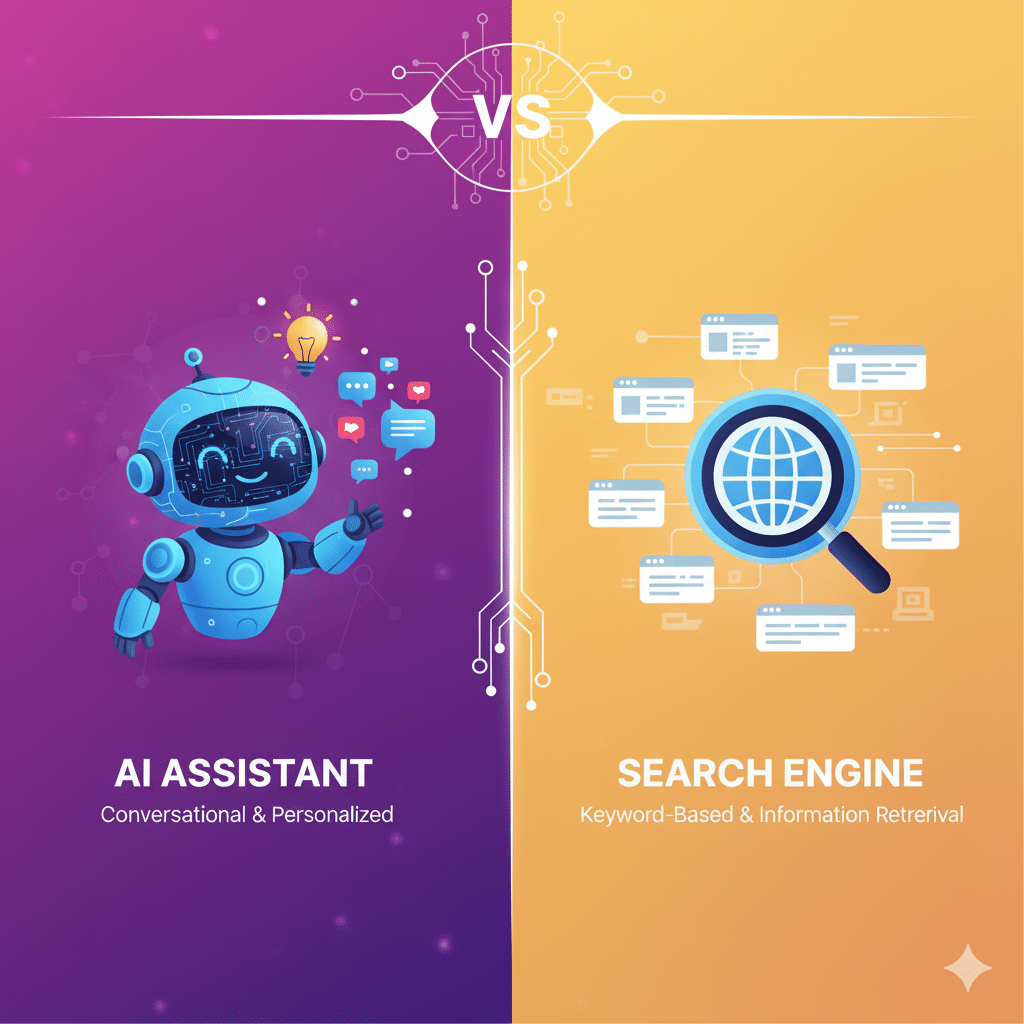
In this post I’ll explain a key change coming to how people find businesses online: the difference between traditional search engines (like Google) and AI assistants (like ChatGPT and similar tools). I made a video on this topic and tested it with a real example — “marketing company in Miami” — to show the practical differences. Below I’ll break down what I found, why it matters for your business, and what you can do now to prepare.
How traditional search engines work
When someone uses a search engine such as Google, the engine typically returns a results page that points to websites, maps, and ads. The search engine lists several websites, local results (the local pack), and often paid ads in the top slots. Users must click through to the website or contact information to learn more.
- Result format: links to websites, local pack entries, ads and reviews.
- Visibility method: sites rank via SEO, local SEO, and paid advertising.
- User action: the user sees multiple options and chooses which websites to visit for details like phone numbers, pricing, or case studies.
How AI assistants work
AI assistants do something different: instead of just pointing you to websites, they read and synthesize information from multiple sources and deliver a summarized answer. In my experiment, instead of showing dozens of links, an assistant produced a short list of agencies and a quick summary of what each one specializes in.
- Result format: summarized answers that combine information from multiple websites.
- Sources: assistants often reference a few sites (sometimes a Wikipedia entry or agency pages), but they don’t always display full contact details.
- Follow-up queries: assistants often invite refinement, for example offering to generate price estimates or tailor results by budget or niche.
“It’s going to read them all and then it’s going to give you a result… ‘Oh, here’s the website, this website where I got this information.'”
Key differences you need to understand
These are the main distinctions I’ve observed and why they matter:
- Presentation: Google shows many options, ads, and a local pack. An AI assistant provides a shorter, conversational summary.
- Monetization: Search engines sell ad space and spotlight sponsored results. Most AI assistants today don’t display third-party ads in the same way — users often access them through subscriptions.
- Transparency: With search engines you can inspect where information comes from by clicking links. With assistants, the ranking logic and source selection are often opaque — you may not know why one company is suggested above another.
- Actionability: Search results usually link directly to contact info or websites. AI summaries may require the user to ask for links or visit sites for phone numbers and pricing.
“You don’t know why that company comes out above the others… It’s not known anymore.”
Opportunities for businesses
Even though AI assistants are still evolving, there are several clear opportunities for entrepreneurs and agencies:
- New discovery channel: AI assistants will become another way prospects find businesses — if your content is readable and authoritative, it can be included in their summaries.
- High-quality leads: People using assistants often have more specific intent (they ask follow-up questions, request price estimates, or narrow by specialization). That can create higher-quality leads.
- Services to offer: SEO will remain important, but new services around “AI visibility,” content optimization for summarization, and structured data could be high-demand.
- Competitive edge: Early adopters who optimize content for AI assistants may capture visibility before the market fills up.
Challenges and dilemmas
There are still unknowns and risks to consider:
- Opaque ranking: You can’t always determine why an assistant chose the sites it did, which makes optimization difficult.
- Less direct contact info: Assistants often summarize without providing immediate phone numbers or contact buttons, so conversion paths change.
- Inconsistent results: AI assistants can give different answers to the same query or change the list when asked again.
- Dependence on third-party models: Your visibility may depend on how a particular model was trained and which sources it prefers.
Practical steps to prepare your business
Here are concrete actions you can take now to improve your chances of appearing in both search engines and AI assistant responses:
- Keep strong SEO fundamentals: good on-page SEO, local SEO (Google My Business), and solid backlink profiles remain essential.
- Use clear, structured content: write concise summaries on your pages, use headings, lists, and clear service descriptions that an AI can easily parse and quote.
- Add structured data: implement schema markup for businesses, services, reviews, pricing, and FAQs so machines can understand your content better.
- Publish authoritative content: case studies, results, and niche-focused pages (for example, “marketing for Latino brands in Miami”) help assistants pull relevant summaries.
- Encourage reviews and local signals: AI assistants may read review content, so reviews and local citations still matter.
- Monitor and experiment: test queries in AI tools, track which pages get referenced, and adapt your content strategy accordingly.
Example: “Marketing company in Miami”
When I tried this search in Google, the results showed the local pack, ads, and many website links. In an AI assistant (ChatGPT-style), the response was a short list of 4–6 agencies with brief descriptions and a suggestion to provide price estimates or tailored lists if I wanted more detail.
This example highlights two points: AI assistants produce concise, conversational answers but often omit direct contact details; and the exact set of results can vary between assistant sessions. Despite the variability, AI assistants are already useful for research and will influence how users decide which company to contact.
Conclusion
The future of search includes both traditional search engines and AI assistants. They serve similar goals — helping users find information — but they do it differently. As business owners and marketers, the takeaway is simple: keep investing in SEO and structured, authoritative content, while also experimenting with content formats and strategies that make your business easy for AI assistants to find and summarize.
If you want help testing how your site appears to AI assistants or optimizing your content for this new landscape, I can help — and I’ll continue sharing what I learn as these systems evolve. Don’t stop learning; the way people search is changing fast.
Salazar Digital Local Marketing
1172 Murphy Ave #208, San Jose, CA 95131
(408) 532-5118


